|
Series
|
Model / Type
|
Symbol
|
Function Description
|
Pneumatic fitting
|
Action characteristic
|
Typical scenarios
|
|
3A Series (3/2 Way)
|
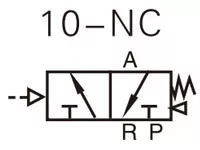
10-NC (Normally Closed)
|
|
Pilot ON: P →A
Pilot OFF: A →R (Exhaust)
|
3A110-M5/ 06: PC -01(G1/8)X2 piece,Silence G1/8 X1 piece
3A210-06/08 : PC -02(G1/4)X2 piece,Silence G1/4 X1 piece
3A310-08/10 : PC -03(G3/8)X2 piece,Silence G3/8 X1 piece
3A410-15 : PC -04(G1/2)X2 piece,Silence G1/2 X1 piece
|
Spring Return:
NC/NO Switch: Actuates when air signal is present; resets by spring force when signal is removed.
|
Controlling Single Acting Cylinders
• Air Blow / Cooling Systems:Blow when there is a signal, stop when there is no signal
• Safety cut-off circuits (Fail-safe)
Immediately shut off the gas circuit if the signal source is lost.
|
|
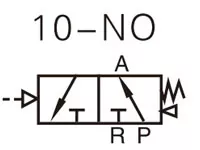
10-NO (Normally Open)
|
|
Pilot ON: A→ R (Exhaust)
Pilot OFF: P→ A
|
|
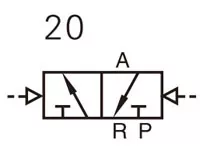
20 (Double Pilot)
|
|
Signal 1: Pilot ON: P →A
Pilot ON: A→ R (Exhaust)
Signal 2: Pilot ON: A→ R (Exhaust)
Pilot OFF: P→ A (Air In)
|
|
Memory/Bistable
Memory Function: Valve stays in the last switched position even if the signal is removed. Requires a counter-signal to reset.
|
Pneumatic Logic Circuits (Non-electric)
• Signal holding systems
• Hopper gate control (Open/Hold/Close)
|
|
4A Series (5/2 Way)
|
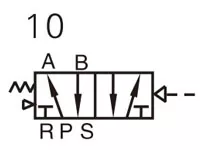
10 (Single Pilot)
|
|
Pilot ON: P → B, A → R
Pilot OFF: P → A, B → S
|
4A110-M5/ 06: PC -01(G1/8)X3 piece,Silence G1/8 X2 piece
4A210-06/08 : PC -02(G1/4)X3 piece,Silence G1/8 X2 piece
4A310-08/10 : PC -03(G3/8)X3 piece,Silence G1/4X2 piece
4A410-15 : PC -04(G1/2)X3 piece,Silence G1/2 X2 piece
|
spring Return
Standard Directional Control: Cylinder extends with signal; automatically retracts when signal stops.
|
Controlling Double Acting Cylinders
• Automatic Press Machines:The worker steps on the pneumatic foot valve to give a signal, and the cylinder presses down; Release your foot, the cylinder will automatically rebound
• Pneumatic Safety Doors:The door opens when there is a gas signal, and automatically closes when there is no signal.
|
|
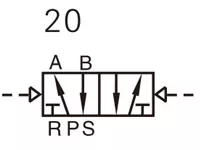
20 (Double Pilot)
|
|
Signal 1: P → A, B → S
Signal2: P → B, A → R
|
|
Memory/Bistable
Pulse Control: Requires only a short air pulse to switch and hold position. Ideal for long-distance signal transmission.
|
Long Conveyor Systems
• Clamping fixtures requiring Power-off Memory
• Flipping mechanism: After the cylinder reaches its end position, it remains in place without dropping even if the signal source is cut off
|
|
4A Series (5/3 Way)
|
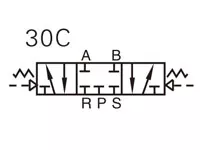
30C (Closed Center)
|
|
No Signal: All Ports Closed (A/B Blocked)
Signal 1: P → A ,B→ S
Signal 2: P → B,A→ R
|
4A130CEP-M5/ 06: PC -01(G1/8)X3 piece,Silence G1/8 X2 piece
4A230CEP-06/08 : PC -02(G1/4)X3 piece,Silence G1/8 X2 piece
4A330CEP-08/10 : PC -03(G3/8)X3 piece,Silence G1/4X2 piece
4A430CEP-15 : PC -04(G1/2)X3 piece,Silence G1/2 X2 piece
|
Stop & Hold
The cylinder stops immediately at its current position (acts like a brake).
|
Emergency Stops
• Vertical Lifting (Preventing drops)
• Mid-stroke positioning
|
|
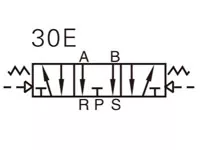
30E (Exhaust Center)
|
|
No Signal: A → R, B → S (Exhausting)
Signal 1: P → A,B→ S
Signal 2: P → B,A→ R
|
Free Movement
The piston loses pressure and can be moved manually by hand.
|
Manual Setup/Debugging:When the machine is stopped, the operator needs to manually move the cylinder to adjust alignment or change molds.
• Releasing residual pressure (Safety):
• "Floating" applications:follow-up mechanism: Used when the cylinder needs to move freely and follow an external force.
|
|
|
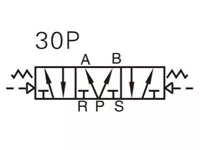
30P (Pressure Center)
|
|
No Signal: P → A, B (Pressurized)
Signal 1: P → A,B→ S
Signal 2: P → B,A→ R
|
Equilibrium/Extend
Maintains pressure balance (Note: Single-rod cylinders will slowly extend;If it is a dual-rod cylinder, it remains in a force-balanced state.).
|
Pressure Balancing Systems
• Preventing retraction in specific vertical setups(Less common):When installed vertically with the rod facing downward, the cylinder uses the differential area force to counteract gravity and prevent retraction.
|